jueves, 15 de abril de 2021

Birding Madrid, Guadarrama National Park. Pajareando por Madrid, Parque Nacional Sierra de Guadarrama.


Hola una vez más.
Hi again.

En el siguiente enlace podéis ver nuestros próximos viajes fotográficos y de observación de aves y mamíferos nacionales y al extranjero. Espero que os gusten y os animéis a venir conmigo. Una experiencia que nunca olvidareis. Estos viajes están condicionados a la situación en que se encuentren los destinos con respecto a la pandemia del coronavirus.
In the following link you can see our next national and foreign Birds and Mammals photographic and observation trips. I hope you like them and I encourage you to come with me. An experience that you will not forget. These trips are conditioned to the situation in which the destinations are with respect to the coronavirus pandemic.

Hoy os muestro algunas de las aves que pudimos fotografiar en una excursión a la carta para una persona por el bonito Parque Nacional Sierra de Guadarrama.
Today I show you some of Birds that we were able to photograph on an a la carte trip for one person through the beautiful Sierra de Guadarrama National Park.

El cliente quería ver, y si era posible fotografiar, algunas de la aves que se encuentran en este Parque.
The client wanted to watch, and if it was possible to photograph, some Birds that can be found in this Park.

El día fue bueno pero al ser lunes de Pascua, en algunos lugares de los visitados, había más gente de la que a mi me gusta que haya. Este fue el caso de los mirlos acuáticos europeos (Cinclus cinclus) que nos costó mucho encontrarlos pues estaban escondidos y no fue hasta última hora de la tarde cuando salieron a alimentarse tímidamente.
The day was good but since it was Easter Monday, in some of the places we visited, there were more people than I like there are. This was thw case of the White-throated Dipper, we had a hard time finding them because they were hidden and it was not until late in the afternoon when they came out to feed timidly.


Lo primero que hicimos en cuanto llegamos a la Sierra fue ir a ver los piquituertos comunes (Loxia curvirostra). No pudimos estar mucho tiempo y las fotos no fueron todo lo buenas que a mi me gusta. 
The first thing we did as soon as we got to the Sierra was to go spot Common Crossbills. We couldn't stay long and the photos weren't as good as I would like.


Los tuvimos muy cerca pero la luz donde se posaban era pero que mala y al ser en piedra tampoco destacaban nada. En esta foto hay dos, a ver quien es capaz de verlos sin fijarse bastante.
We had them very close but the light where they perched was bad and as they had been on stones they did not stand out at all. In this photo there are two, who is able to see them without looking closely.


También vimos varios ejemplares de escribano montesino (Emberiza cia).
We also saw several specimens of Rock Bunting.


Posiblemente el ave más abundante durante este día fue el carbonero garrapinos (Periparus ater).
Possibly the most abundant Bird on this day was the Coal Tit.


Les veías y oías por todos los lados.
You could see and hear them every where.


Otra de las estrellas del Parque Nacional son los verderones serranos (Serinus citrinella). En la foto un macho.
Another of the stars of this National Park is the Citril Finch. In the photo a male.


Fue una pena que entre el verderón serrano (Serinus citrinella) y yo hubiese un obstáculo.
It was a pity that there was an obstacle between the Citril Finch and me.


Muchos machos estaban cantando pues es época de cría.
Many males were singing as it is breeding season.


Esta hembra estaba ya cogiendo material para hacer su nido.
This female was already gathering material to make her nest.


Las aves residentes estaban haciendo ya sus nidos pero había muchas otras que estaban en paso migratorio en dirección norte como fue el caso de muchos de los jilgueros europeos (Carduelis carduelis) que vimos.
Resident Birds were already making their nests while others were migrating northward, as was the case with many of the European Goldfinch we saw.


Al igual que en otras ocasiones vimos varios buitres negros (Aegypius monachus). Ninguno pasó cerca nuestro.
As on other occasions we saw several Black Vultures. None passed close to us.


Sin embargo, este colirrojo tizón (Phoenicurus ochruros) macho lo tuvimos muy cerca.
However, this male Black Redstart was very close to us.


Son preciosos.
They are beautiful.


También vimos varias parejas de reyezuelos listados (Regulus ignicapilla).
We also saw several pairs of Firecrest.


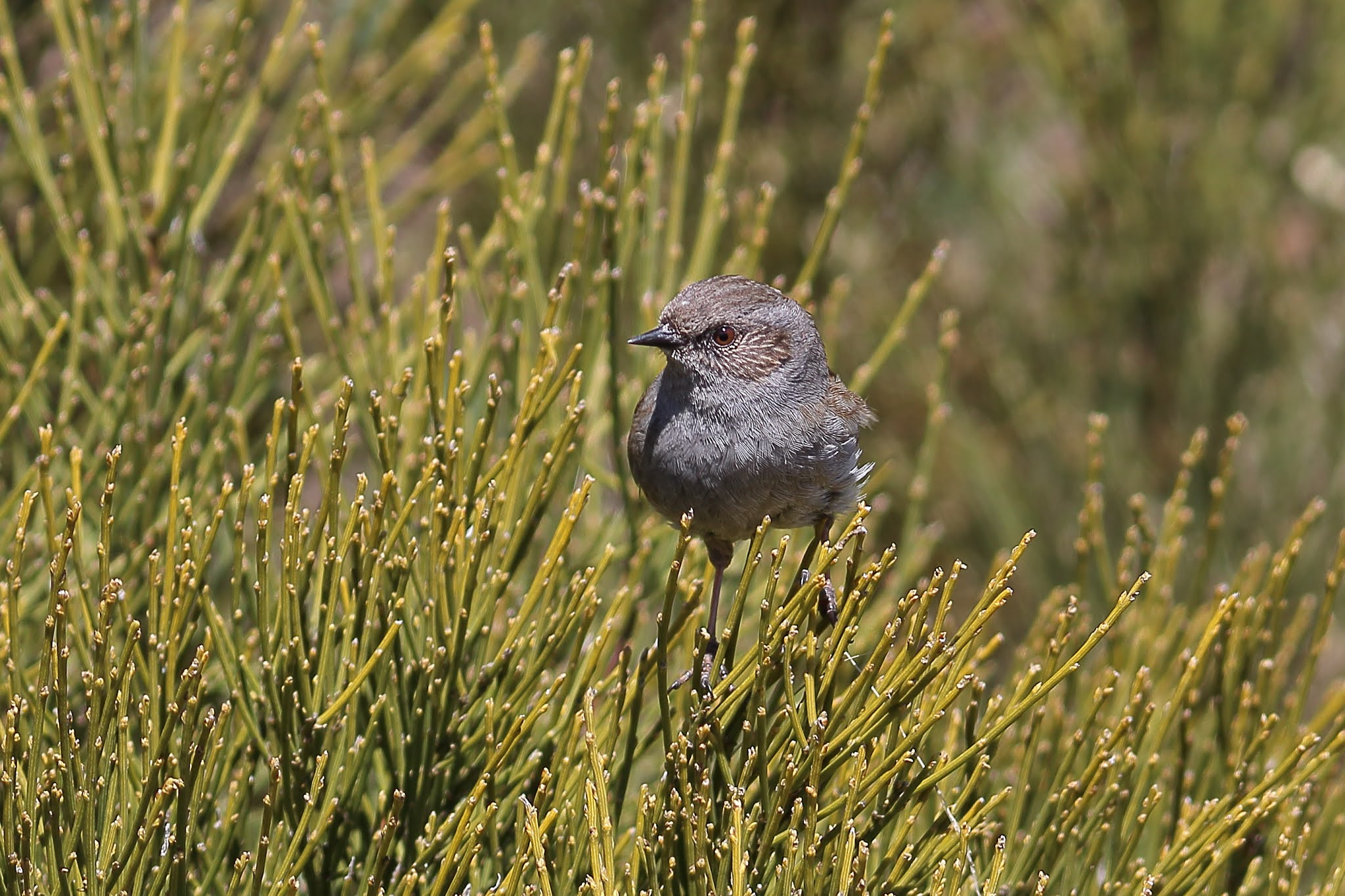
Acentor común (Prunella modularis).
Dunnock.


Ya se podían ver algunas mariposas como es el caso de esta limonera (Gonepteryx rhamni) aunque estaba muy deteriorada. Si os habéis fijado estaba en un narciso silvestre que ya se podían ver por los campos.
You could already see some butterflies such as this Brimstone  although it was very deteriorated. If you have noticed it was in a wild Daffodil that could already be seen on fields.


Para mi este es el herrerillo más bonito, el herrerillo capuchino (Lophophanes cristatus).
For me this is the most beautiful Tit, the Cressted Tit.


La primera águila calzada (Aquila pennata) que veo este año. Se trata de un bello ejemplar morfo claro.
The first booted eagle (Aquila pennata) I see this year. It is a beautiful pale morpho specimen.


Mientras intentábamos encontrar a los mirlos acuáticos europeos (Cinclus cinclus), vimos al menos una pareja de lavanderas cascadeñas (Motacilla cinerea). En las fotografías os muestro al macho que a pesar de ser muy esquivo, la hembra lo era mucho más.
While we were trying to find White-throated Dipper, we saw at least a pair of Gray Wagtails. In the photographs I show the male that despite being very elusive, the female was much more so.


No es la primera vez que veo un visón americano (Neovison vison) en este tramo del río.
It is not the first time I have seen an American Mink in this stretch of the river.


Después de mucho buscar, aparecieron los deseados mirlos acuáticos europeos (Cinclus cinclus).
After much searching, the desired White-throated Dipper showed up.


No me extraña que tardásemos mucho en verlos pues con la cantidad de gente que había por las márgenes del río y lo tímidos que son debieron pasar la mayor parte del día escondidos.
No wonder it took us a long time to see them because with so much people on the riverbanks and how shy they are, they must have spent most of the day hidden.


Me encanta ver cómo se sumergen en el agua en busca de alimento.
I love watching them dive into the water in search of food.


Y para finalizar con el relato os dejo unas fotos del macho de pico menor (Dryobates minor) que también, después de mucho buscar, conseguimos ver.
And to finish with the story I leave you some photos of the Lesser Spotted Woodpecker that also, after much searching, we managed to spot him.


Si queréis suscribiros a este blog de los viajes que hacemos pincha en el siguiente enlace: Suscribirse y haz clic en ¿ Quieres suscribirte a nuestro blog?
If you want to subscribe to this post about the trips we do, click on the following link: Susbcribe and click on: Do you want to subscribe to our blog?

Espero que os haya gustado y hasta pronto.
I hope you like it and see you soon.

jueves, 8 de abril de 2021

La avutarda común. The Great Bustard.


Hola una vez más.
Hi again.

En el siguiente enlace podéis ver nuestros próximos viajes fotográficos y de observación de aves y mamíferos nacionales y al extranjero. Espero que os gusten y os animéis a venir conmigo. Una experiencia que nunca olvidareis. Estos viajes están condicionados a la situación en que se encuentren los destinos con respecto a la pandemia del coronavirus.
In the following link you can see our next national and foreign Birds and Mammals photographic and observation trips. I hope you like them and I encourage you to come with me. An experience that you will not forget. These trips are conditioned to the situation in which the destinations are with respect to the coronavirus pandemic.

Hoy os voy ha hablar del gigante de las estepas cerealistas españolas. La avutarda común (Otis tarda).
Today I am going to talk to you about the giant of the Spanish cereal steppes. The Great Bustard.

La avutarda común son grandes aves pertenecientes a la familia de los Otidae y es el único representante del género Otis. Se la conoce con el nombre científico de Otis Tarda. Hay reconocidas dos subespecies, Otis tarda tarda que está distribuida por Europa, norte de África y oeste de Asia. La otra subespecie es la Otis tarda dybowskii que son los ejemplares del este de Asia.
The Great Bustard are large birds belonging to the Otidae family and it is the only representative of the Otis genus. It is known by the scientific name of Otis tarda. There are two recognized subspecies, Otis takes lateOtis tarda tarda, which is distributed in Europe, North Africa and West Asia. The other subspecies is the Otis tarda dybowskii, which are the specimens from East Asia.

Las poblaciones de África y Europa son sedentarias mientras que las asiáticas hacen migraciones desde el norte hasta el sur para pasar el invierno.
The populations of Africa and Europe are sedentary while the Asian ones migrate from the north to the south to spend winter.

Aunque son una especie considerada como residentes, es cierto que realizan movimientos estacionarios de bastante distancia relacionados con las estaciones del año, siendo las hembras las que más realizan este tipo de desplazamientos. En cualquier caso, se trata de un ave gregaria.
Although they are a species considered as residents, it is true that they carry out stationary movements of quite a distance related to the seasons of the year, with females being the ones that carry out this type of movement the most. In any case, it is a gregarious Bird.


Grupo de avutarda comunes machos en primavera.
Flock of male Great Bustard in spring.

En España se encuentran distribuidas en las llanuras cerealistas de ambas Castillas y Extremadura y núcleos menos importantes en Andalucía, Aragón y Murcia. 
In Spain they are distributed in the cereal plains of both Castillas and Extremadura and less important nuclei in Andalusia, Aragon and Murcia.


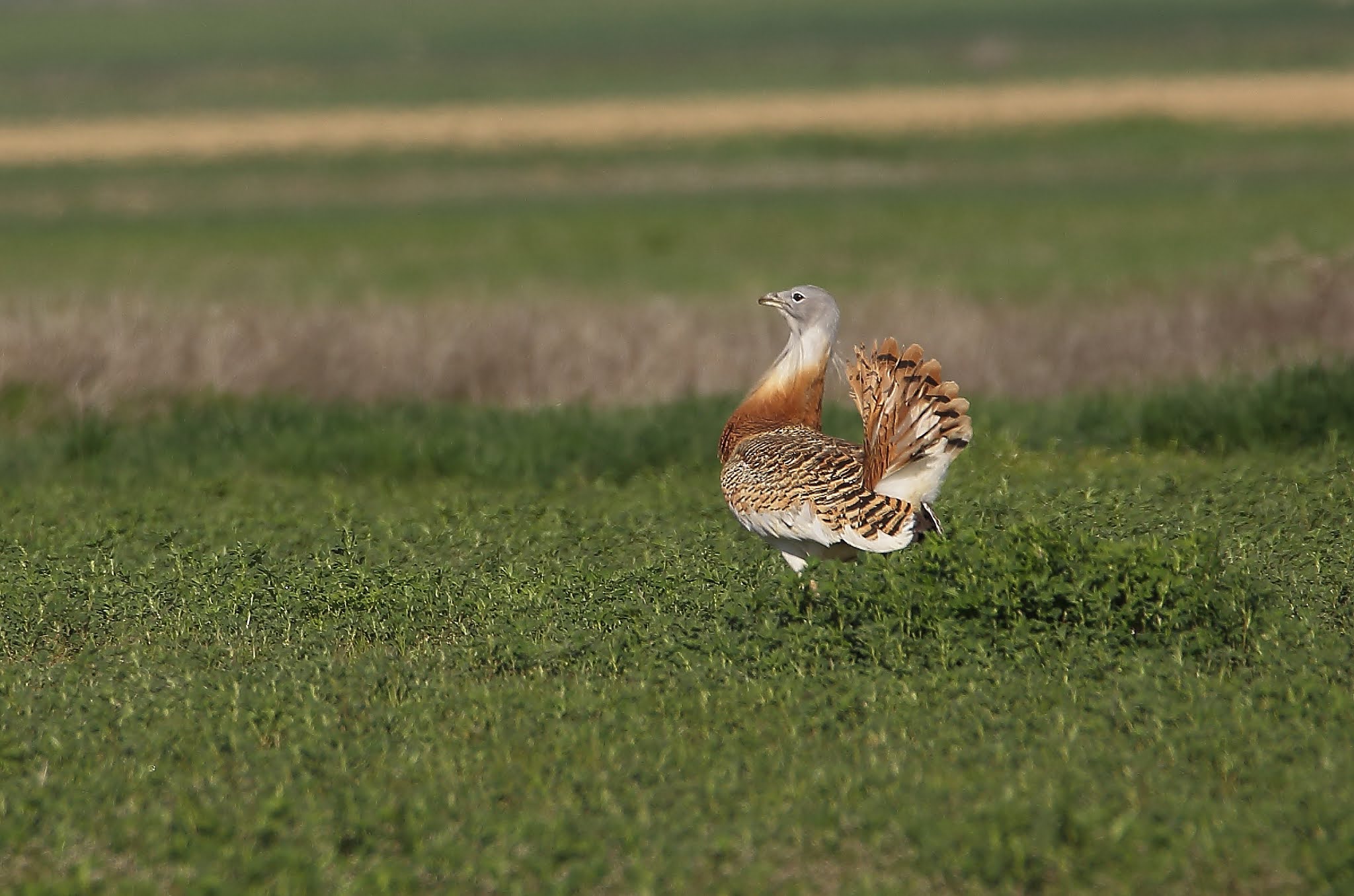
Macho de avutarda común en plumaje nupcial.
Male Great Bustard in breeding plumage.

Son aves muy corpulentas y pesadas que les gusta pasearse por los campos cerealistas de nuestro territorio. Existe mucha diferencia entre los machos y las hembras en cuanto al tamaño y su peso.
Male bustard in nuptial plumage. They are very stout and heavy Birds that like to walk through the cereal fields of our territory. There is a lot of difference between males and females in terms of size and weight.


Los machos pueden alcanzar una altura de 90 a 105 centímetros y una envergadura de 2,1 a 2,7 metros. Su peso oscila de 9,5 a 16 kilogramos, aunque el récord en España lo ostenta un macho que llegó a pesar 19 kilogramos. Por ello la convierte en una de las aves voladoras más pesadas del mundo.
Males can reach a height of 90 to 105 centimeters and a wingspan of 2.1 to 2.7 meters. Their weight ranges from 9.5 to 16 kilograms, although the record in Spain is held by a male who weighed 19 kilograms. For this reason, it makes it one of the heaviest flying birds in the world.

Además de su tamaño, el macho se diferencia de la hembra por tener un tono más vivo en el dorso de castaños y dorados. Además, el macho en plumaje nupcial presenta unas plumas largas, apuntadas y rígidas que le nacen de la mandíbula inferior.
In addition to its size, male differs from female by having a brighter tone on the back of chestnut and gold. In addition, the male in breeding plumage has long, pointed and rigid feathers that are born from the lower jaw.


Detalle de la cabeza del macho con sus bigotes.
Detail of the male's head with its whiskers.

Las hembras son sensiblemente más pequeñas, un tercio en relación con los machos, midiendo 75 a 85 centímetros de alto y una envergadura alar de 180 centímetros. Su peso medio es de 3,1 a 8 kilogramos.
Females are noticeably smaller, one third in relation to the males, measuring 75 to 85 centimeters high and a wingspan of 180 centimeters. Their average weight is 3.1 to 8 kilograms.


Hembra de avutarda común menos llamativa que el macho.
Less conspicuous female bustard than male.


Carece de los bigotes que el macho desarrolla en plumaje nupcial y su color es más apagado.
She lacks the whiskers that male develops in breeding plumage and its color is duller.


En esta toma se puede ver la diferencia de tamaño entre el macho y las hembras.
In this shot you can see the difference in size between male and he female.

Su alimentación es a base de vegetales e invertebrados, siendo estos últimos su dieta predilecta en primavera y comienzos del verano donde los saltamontes y los grillos son ávidamente devorados. Ocasionalmente no descartan algún vertebrado como pequeños roedores y lagartijas. Durante el invierno las leguminosas adquieren su principal fuente de alimento.
Their diet is based on vegetables and invertebrates, the latter being their favorite diet in spring and early summer where grasshoppers and crickets are eagerly eaten. Occasionally they do not rule out some vertebrates such as small rodents and lizards. During winter, legumes acquire their main source of food.

Siempre me impresiona ver lo bien que estas pesadas aves vuelan.  Como su envergadura no es muy grande y su peso es elevado, para alzar el vuelo necesitan dar unos cuantos pasos aleteando fuertemente para poder despegar.
It always amazes me how well these heavy birds fly. As their wingspan is not very large and their weight is high, to take flight they need to take a few steps, flapping strongly to take off.


Un grupo levantando el vuelo.
A flock taking off.


Otro más numeroso y volando a mayor altura.
Another more numerous and flying higher.


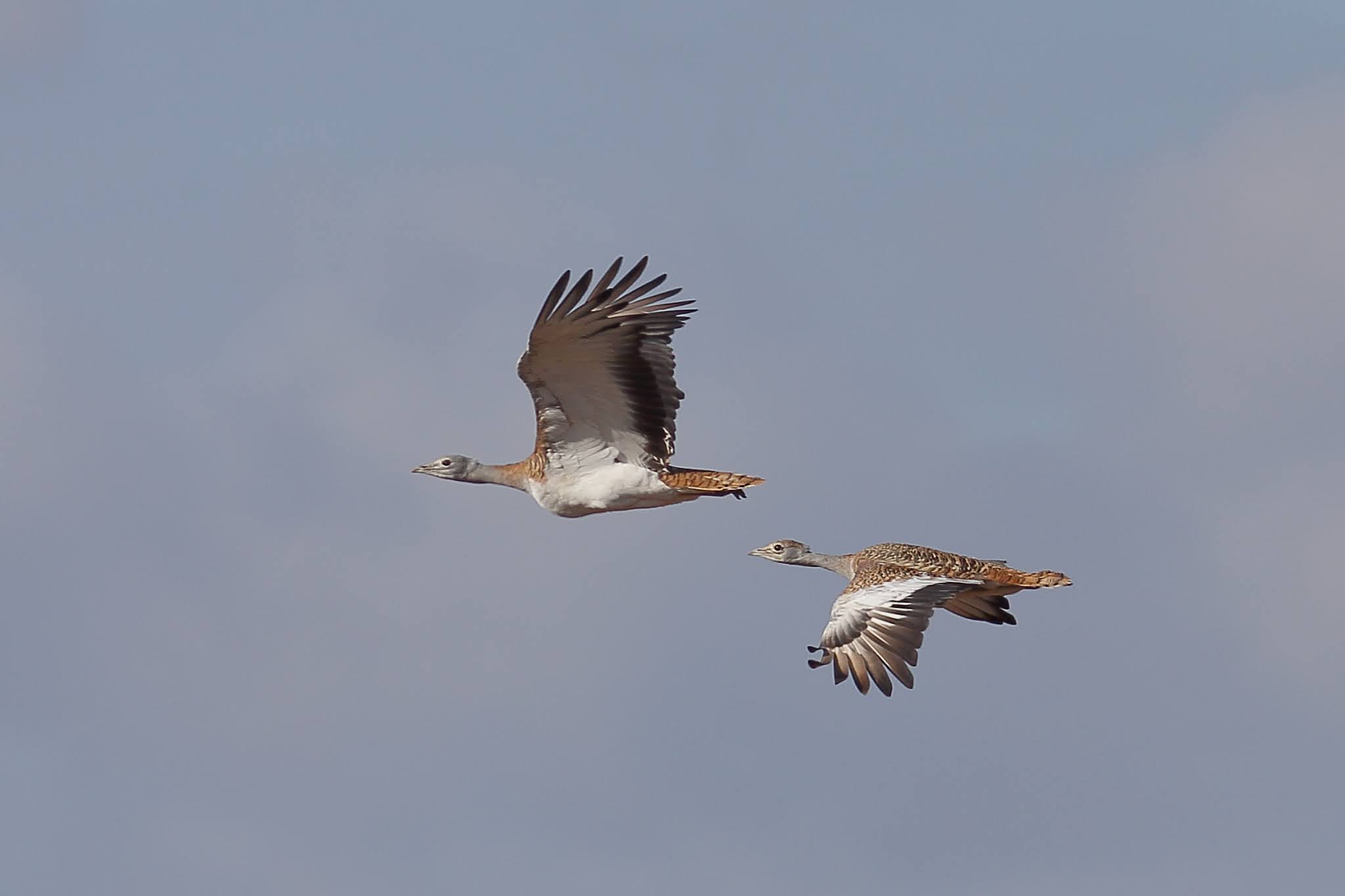
Un gran macho en Vuelo.
A big male in flight.


Otros dos.
Other two.


Dos hembras.
Two females.

El periodo reproductor comienza a mediados de marzo y se extiende hasta junio. Los machos ya comienzan a cambiar su plumaje de invierno a nupcial a mediados de enero y en este tiempo comienzan a luchar para determinar quién ocupara los lugares más vistosos para realizar la parada nupcial que se la llama rueda.

Their breeding period begins in mid-March and lasts until June. Males already begin to change their plumage from winter tobreeding in mid-January and at this time they begin to fight to determine who will occupy the breter  places to make the beeding display called "la rueda".


Machos midiendo fuerzas.
Males measuring their strength.


Durante esta época los machos caminan pavoneándose con la cola levantada y con su plumaje nupcial que es muy bonito.
During this time males strut around with their tails raised and with their breeding plumage which is very beautiful.


Algunos machos pavoneándose.
Some males strutting.


Pero lo que más impresiona de estas grandes aves es su ciclo reproductivo. Desde mediados de marzo a principios de mayo los machos se congregan en una amplia zona donde realizan las paradas nupciales, Las Ruedas. Este tipo de comportamiento recibe el nombre de lek agregado o lek poligínico disperso.
But what is awesome about these large Birds is their brreding cycle. From mid-March to early May, males congregate in a large area where they make their breeding display, "Ruedas". This type of behavior is called an aggregate lek or sparse polygynous lek.


Las manchas blancas diseminadas por los cultivos son los machos de avutarda común realizando la rueda.
The white spots scattered throughout the crops are the male Great Bustard making the "rueda".


Macho haciendo la rueda y una hembra que se acerca a ver si le gusta ese macho.
Male performing the "rueda" and a female who comes to see if she likes that male.

El plumaje reproductor de los machos ya está listo en enero y es desde este momento hasta el comienzo de las paradas nupciales cuando los machos establecen sus dominancias entre sus grupos. Tras la cópula, las hembras depositan en una ligera depresión en el suelo los 2 o 3 huevos que componen la puesta y que incuban durante 21–28 días. Son ellas las que llevan a cabo todo el proceso de incubación y cuidado de los pollos.
The breeding plumage of males is already on in January and it is from this moment until the beginning of the breeding cycle when males establish their dominances among their groups. After copulation, females deposit the 2 or 3 eggs that make up the clutch in a slight depression in the ground and which incubate for 21–28 days. They are who carry out the entire process of incubation and care of  chicks.


Un gran macho en el primer estado de la parada nupcial o rueda.
A large male in the first stage of the nuptial parade or "rueda".

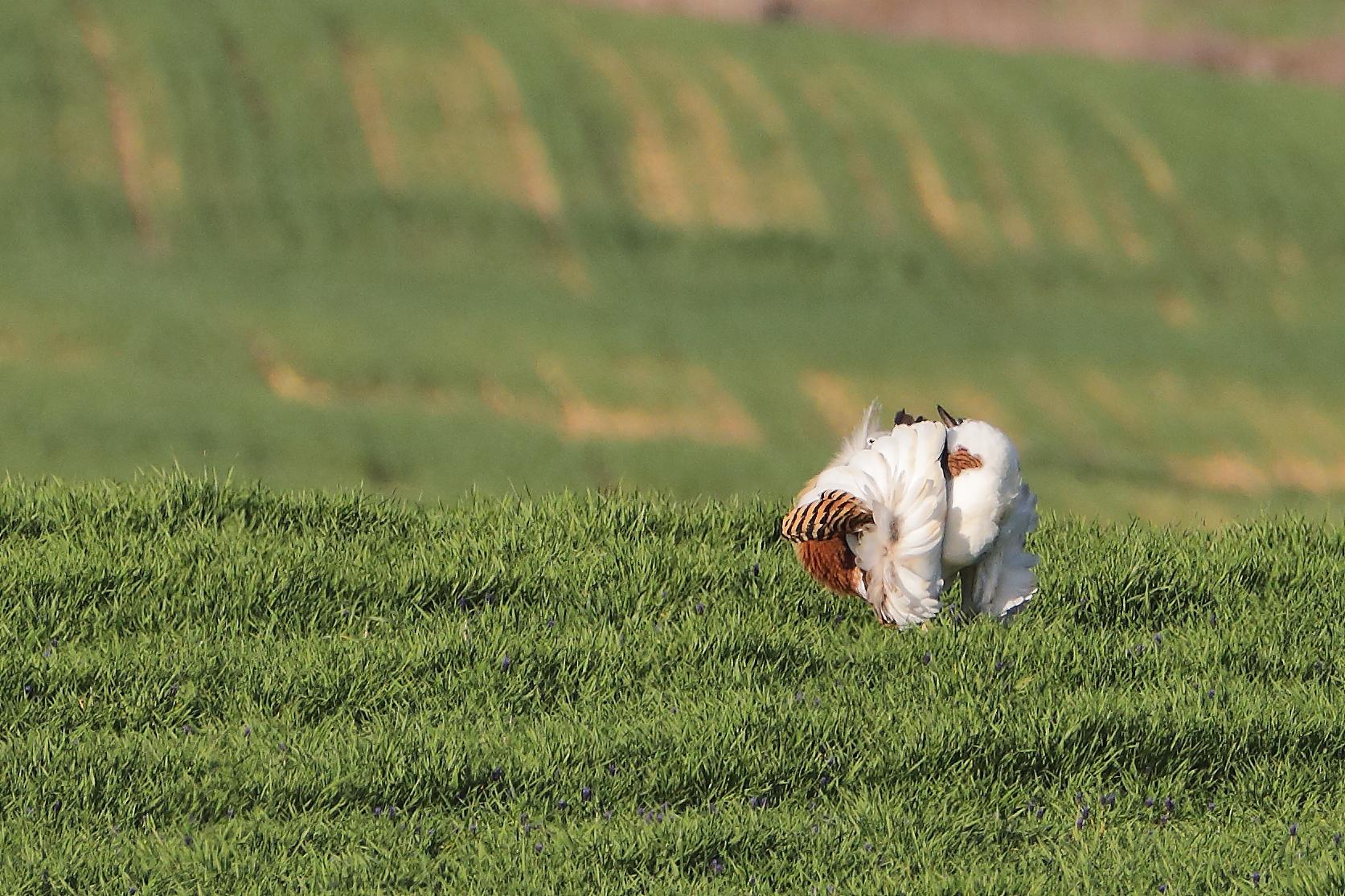
Acto seguido, se inclina hacia delante, gira las alas exponiendo su plumaje blanco y con las plumas secundarias hacia arriba. Las bigoteras rectas hacia arriba escondiendo su pico. Las bigoteras las mueve indistintamente pues cuando se acerca una hembra puede bajar la del lado de la hembra para verla mejor. En resumen, se convierte en una bola blanca.
Then, it leans forward, turns its wings exposing his white plumage and with the secondary feathers up. The whiskers straight upwards hiding their beak. Whiskers are moved indistinctly because when a female approaches, he can lower the one on the female's side to see her better. In short, it becomes like white ball.


Unas imágenes valen más que mil palabras.
It is better to show you with some photographs.


Como durante esta fase del cortejo las avutardas están muy expuestas, se recomienda su observación a bastante distancia con la utilización de telescopios terrestres pues ellas mantendrán una distancia bastante grande con los observadores.
As during this phase of the courtship Great Bustards are very exposed, it is recommended to observe them at a considerable distance with the use of ground-based telescopes since they will maintain a fairly large distance from the observers.

Si queréis suscribiros a este blog de los viajes que hacemos pincha en el siguiente enlace: Suscribirse y haz clic en ¿ Quieres suscribirte a nuestro blog?
If you want to subscribe to this post about the trips we do, click on the following link: Susbcribe and click on: Do you want to subscribe to our blog?

Espero que os haya gustado y hasta pronto.
I hope you like it and see you soon.